Friday, 10 June 2016

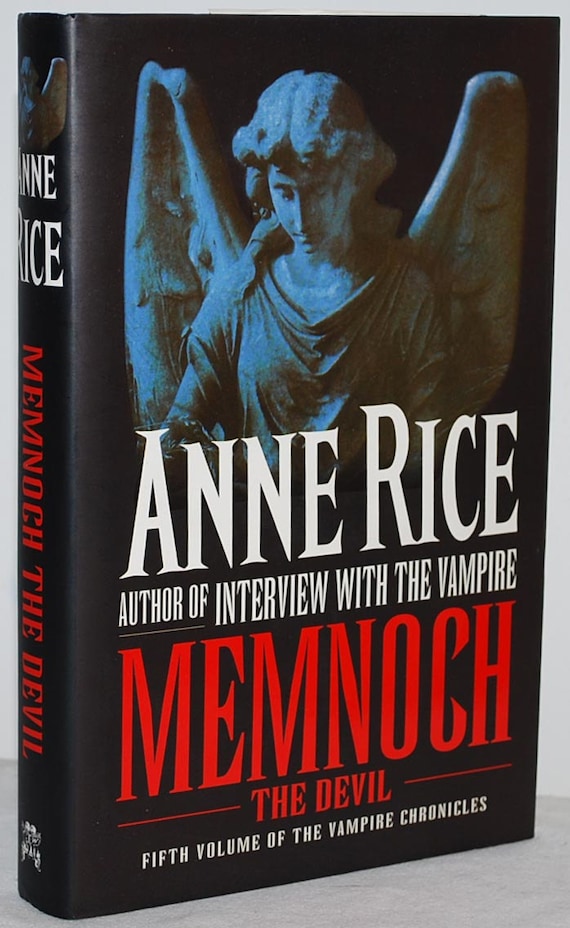
'Memnoch The Devil' - huh, that ending?

I've only just finished reading Anne Rice's novel (1995, I believe) for the second time. The last time I read it, I was around 13 years of age (I'm 17 now) so I didn't exactly understand it, not with it's sophisticated register and complexity in terms of outlooks and views on religion. Reading it again, it made a lot more sense to me; however, the ending still puzzled me!

Beware that there will be spoilers in this post...and if you haven't already read any of Anne Rice's Vampire Chronicles, I suggest you do. 

At the end, in the last chapter, I think it is, Maharet - the second oldest vampire in the whole population of vampires - gives Lestat a package containing a message from Memnoch (the devil) along with his missing eye. Why did Maharet have the package? Why would Memnoch give it to her - is she in on this whole bringing-Christianity-back-into-prominence mission? The book is very vague, frustratingly. 

What is even more angering, though, is Memnoch's message to Lestat, in blood/soot writing, "To My Prince, my thanks to you for a job perfectly done. My love, Memnoch the Devil." Throughout the novel, Memnoch had been trying to persuade Lestat to side with him - to help him purge the souls of Sheol (Hell) so they could go into Heaven. It's Memnoch's job to do this because in the past he complained too much about God being impassive to the suffering of the souls of Sheol. Some simply passed straight into Heaven, others became trapped in Sheol - and this could depend on the spontaneity of chance, or the amount of suffering the souls have felt. Memnoch thought it was unfair that those who suffer should stay in Sheol because the suffering brought them into sin, where as those who barely suffered anything went straight into Heaven. It's just not fair, as Lestat and Memnoch agreed on. Hence, Memnoch wanted to help all of those trapped souls in Sheol to ascend to Heaven - to be "worthy" of God and his Paradise - as he felt a compassion for mankind that God simply did not have. He referred to those souls in Sheol to stones on a shore. So, God left Memnoch in charge of Sheol. 

Meanwhile, during Memnoch's entrapment in Sheol, with no choice but to help purge the souls in there - for who else will do it? - Memnoch is also having another argument with God. He believes that suffering is pointless, that without it, the stages of the human mind that reveal the will to do sin and to inflict suffering on others, would never be. That stage in the human mind is what's keeping the souls in Sheol and not going to Heaven - so why have it? This is what Memnoch cannot understand and constantly, he is mocked and laughed at by the Lord, because of his "simple angelic mind." In God's eyes, suffering is part of the cycle of Nature and without it, there would not be glory in human life - there is magnificence in the grotesque murders during wars, in the "speared" infants along the roads... Here is where I started to understand Lestat when he said that God was "mad." I believe that without suffering - and freewill is what allows it to happen, and without freewill, there would be no point in living - the quality of life would fade into nothingness. How can you be grateful for true love when it comes around if you've had 50 odd lovers before, who you were each madly in love with? The clarity of what is, shall we say, good, is seen when in contrast with what is "evil," such as suffering. 

But anyway, so Memnoch wanted to prove God wrong, that suffering is not what humans need to be purged - they need love and the intimacies they feel when with each other - so he tells Lestat that he wants to change mankind's minds about God. He wants to put a stop to Christianity, because it is the root of the idea that suffering is purgatory - is pure and good, the way to reach the Lord in Heaven. He frequently boasts to Lestat, "I'm winning," because mankind have grown to "hate" God for his allowance of suffering to innocents and his passivity towards humans. At least in the 21st Century. 

This is what really puzzled me - that message at the end from Memnoch. It implies that Memnoch is pleased that Lestat escaped Sheol with Veronica's Veil, then revealed it to the world, solidifying human faith in God and Christianity once again. After all, he tries to stop Lestat from leaving Sheol and even cries at Lestat's deserting him - he pulls Lestat's eye out (accidentally apparently) in his efforts to stop him from leaving, then looks horrified at his doing. But then it is implied that Memnoch planned to take Lestat's eye all along, because of his mention of 'Uncle Mickey's eye' - Dora's uncle - and as this is a novel, we can't dismiss anything as a coincidence, can we? Anyhow, what I wanted to know was: why did Memnoch thank Lestat for doing the exact opposite of what he said he wanted? 

I've been reading online all sorts of theories, which vary from: the Devil is a liar and this was Anne's way of reminding us of that, Anne wanted to reveal to us how lies are sometimes easier to accept, the truth less so, or even that Memnoch was working alongside God. Perhaps he wanted to return to Heaven, so he gave in to God, and decided that suffering could be used to purge the souls of mankind, so they could go into Heaven. Or perhaps he wasn't the devil at all? Apparently Rice suggested this very notion at a book signing, which would suggest that God used another of his servants to pretend to be Memnoch, because he knew that he was losing. After all, Memnoch showed little resistance when God told Lestat to take the veil - perhaps that whole "He's got the veil! Don't let him take the veil," was an act. This is further supported by the fact that each time Lestat has fought Memnoch, he's been able to knock him backwards. Really? A vampire is as strong as the devil? Perhaps, seeing as Lestat has drunk blood from the First Brood vampires plenty of times, but it doesn't make sense if an "earthbound" creature is as strong as or stronger than a Heavenly species. Therefore, I'm settling for Memnoch's weakness as either the shock of betrayal (becasue Lestat's leaving him to win the game with God on his own), or an act. 

Another puzzling thing for me is: why on earth (excuse the pun) did Memnoch lie and pretend to be against God and Christianity's rebirth in human society, if he actually wasn't? Was it because he knew that Lestat "hated" God, so he pretended to as well, then Lestat would trust him more? I know that the inclusion of the Veil during Lestat's tour of Hell, Heaven and Earth is not a fluke. Just as I know that Memnoch choosing Lestat to be his "lieutenant" is not just chance either, as Lestat was involved with Dora and Roger, her father, who were both suspiciously obsessed with religion and focused their whole lives on it. Obviously, Memnoch and God needed Dora to find the Veil because they knew that she would convert utterly to a new religion and would be determined to show the world and as she is an evangelist, strive to convert everyone else to this new religion (which I believe is Christianity, in its rawest form, what God wanted it to be in the first place). I have a feeling that Memnoch put on this whole act for Lestat and tricked him into believing certain things so that Lestat would almost lose his mind. With the knowledge that he was actually going mad, he wanted to prove that he wasn't and he needed for this chaos in his mind to be not "for nothing", to mean something, so he needed Dora to believe him. What better way to make her believe him, than to show her the Veil? So he did, and God won. 

That is my theory. 

Why Lestat lost his mind in the end, I think it may be because he felt utterly betrayed, that Memnoch would trick him, that this angel who is loving, caring for mankind and fighting for their place in Heaven, would lie to him and use him as a way of reforging the idea that suffering is good and magnificent. Lestat cannot accept that someone who he grew to love, as he admits in the book he loves Memnoch, would lie to him. And last of all, the idea that Memnoch lied about believing in Lestat's Savage Garden - something he'd believed in so adamantly all his life - was devastating to him. 

Moreover, Armand's decision to burn in the sun and sacrifice himself to symbolize the rebirth of Christianity, was a little confusing. Armand seemed content in his life on Earth - he didn't seem unhappy. So why throw away his life? All his life he had submitted to the notion that there is no God or Devil, after letting go of his belief that by serving Satan, we are serving God. Now Lestat has returned from Hell and Heaven, saying things that suggest that yes, we can serve God through the Devil and yes, God and the Devil do exist! It probably drove him out of his mind and made him believe that all his life, he'd wasted himself, taken thousands of lives for four hundred years, for little reason at all, because he had gained nothing during his life on Earth, not even the realisation of the truth. I didn't like Armand's decision, though, despite the fact that he doesn't actually die - he lands in a building, after rising into the sun, near-death and found by two mortals who change his outlook on life. He's always been one of my favourite vampires, despite his tendency to be vain and arrogant, he's interesting and almost lovable. Another website I found suggested that Lestat's revealing of the Veil to the world, causing the vampires to stand before the church and let the sun destroy them, was Memnoch's way of getting rid of many of the vampire population. This way, less vampires would kill to feed, less souls would go into Sheol having suffered a spontaneous, quick death, having died young - having not felt gratitude for life and God's creation because they didn't have enough time - and then Memnoch would win, at the same time that God won. 

I don't think that Memnoch expected anything less from Lestat - he knew he would be a coward and would flee from Hell and his own purgatory, taking the Veil to Earth and ensuring the rebirth of Christianity and Love in God. This is conveyed by his words, "a job perfectly done." Lestat had fulfilled his role unknowingly, "perfectly." 

Anyway, I hope my theories have helped anyone else, who has become very vacillated with the ending of Rice's book, Memnoch The Devil. Please share your own opinions of the ending in the comments section. I'd be very interested to see what other people make of the ending :) Thanks. 
Saturday, 26 March 2016

Some More...

...Inspirational Songs!

Lately, I have been listening to YouTube videos from a channel I have subscribed to. It contains a few unreleased songs from the wonderful artist, Gabrielle Aplin. I have included her songs in some of my posts before, I believe, but for those of you who haven't seen those posts, here's a brief introduction to this young singer/songwriter. 

From age thirteen, she has been writing her own songs, which are usually influenced by the indie-folk genre and artists such as Joni Mitchell, whom she has been listening to all her life having been brought up in a gypsy family. She has made at least three albums now and is becoming more and more popular. Somewhere along the road, her mind darkened and she experienced pain for reasons unknown, which inspired her to express loneliness, insanity and despair in her lyrics. Hopefully, this context will allow you to understand the lyrics in these songs a little more. 

Listen to them and hopefully they might inspire you!


Wednesday, 24 February 2016

A Little Odd Post!

space text religion atheism creationism wallpaper

Okay, so I was doing my English Literature homework and I came upon this as I was searching for images that related to creationism. 

I am an atheist as you may have guessed by now and I have to admit, all human beliefs including atheism are ridiculous! Why? Well, let's look at the following...choices that we have:

  1. A random, gigantic man made all of these balls of rock out of the blue and made miniature, tiny, tiny, tiny creatures on it. But, wait, although humans are his most prominent species, the one he made in his image, he let dinosaurs roam it first, marking their territory. What a traitor! And here we were thinking we were his favorite :(
  2. There are hundreds of men up there called gods and, oh, this is interesting, also lady gods called goddesses. Even though the earth was pure invention, they seem to possess the same features as animals that dwell on the earth, such as elephant eyes and snakes. 
  3. Or, we have the final belief...there really is no reason. Simple really, a few atoms reacted, exploding and expanding, expanding, and streeeetch, there you have it: the universe. There's not a reason why. It's really, just that. We are completely alone, save for the possible aliens out there. 
So you see, I didn't really have much choice when I was faced with the decision of following a belief. Many times I have rethought my choice, thinking, but surely if we're all here and all of this meaning is here, there must be a reason. Sure, there could be a strange, unimaginable entity out there, seeing as the universe is so perfectly built and designed, as though it was constructed by hands or forces. Look at ants. We have gotten many of our architectural ideas from the things that they build. Could this suggest that the universe and all of these atoms and atmospheres work with amazing compatibility? Or, could it tell us there is something out there, making these miracles possible? The raw, fundamental basis of religion such as Christianity is actually quite believable. I just think the author was on cocaine or maybe weed whilst he was writing it. "He made the Universe in Six days and took a nap on the Seventh." No that's not the original passage from Genesis. But that's basically what they are saying to us. Couldn't they have at least made it all believable, let alone readable? Yet, I suppose almost none of the people in England read anything, so the Bible would have been like water to their arid minds. The stories in the Bible are rarely agreeable, rarely cohesive and rarely sensible. Do people really believe that snakes can talk? Do you really believe that we all came from two people - where are the deformed, mutated humans? I'm dismissing cancers and diseases that humans all over the world get because these are the least humans would be experiencing if we all came from one couple. 

Another thing that tells me that the Bible is very unreliable is how sexist it is! God is a man. Why? Because that's how it must be; no, it's how humans have it - alarm bells ringing yet? Humans made up all of the Bible. Women have been condemned, resented and discriminated against up until perhaps the previous century - even now, mind you - all because Eve, damn you, Eve!, ate the apple of knowledge. Now it's all her fault, wait, it's all women's fault that the plague of sin roams the earth. That, everyone, is not fair. What about Adam's submission to eat the apple? Isn't it his fault, too? 

Really, it is just the teachings, thoughts and stories in the Bible that I disagree with. It makes me deeply demoralized when I hear someone saying that they believe all that. 

Now, about that picture above. Atheism makes a lot more sense than Christianity or the other religions spread across the world. The definition that person wrote isn't half true. It's not so black and white, just like religion isn't. Everyone believes different aspects of atheism. Someone might believe in the Big Bang Theory, not that 'nothing happened,' but they don't believe in God creating the universe. 

Christianity wouldn't be so bad if the Bible didn't exist. If Christians followed the simple, understandable belief: God made the universe, it make a lot more sense. We don't need to make assumptions of how he made the universe or - now, now, no need to be so cocky - of how we are the prime, chief species on earth. 

Oh, and if you're still here, read The Handmaid's Tale. Margaret Atwood. That might sum up everything I've said. 

Praise be. 

Sunday, 6 December 2015

Writing a Romance...


Writing a romance is very easy. But writing a good romance is a little more difficult. Writing an amazing, best-selling romance is very difficult. But hey, some people can write like they breathe, as I've said before. But what I am saying applies to the majority of people. Anyway, where do I start?

Romances have a system. Naturally, the human race thinks romantically. It's mostly women, but believe it or not, some men have a little romance in them... I'm not trying to emasculate you, guys, don't worry. But despite the presence of these lovey-dovey cogs in our minds, we get very bored of romance easily. Ever read a romance book, which you've put down disappointedly, after just reading a few pages? Maybe, like me, you'll think, Nah, it'll start up soon, surely, it has to. So you get through a quarter of it, and still it's just...boring! I am adamant that you and I - with the inclusion of all writers - never want our books to dishearten a reader so much. So, good on you for visiting this blog, because I am going to tell you how to avoid that devastating result. 

Back to that system, now. The terminology I am going to use in a second is not made-up by me. I have acquired the words from research. Anyway, in a romance, you have a heroine (the female character) and the hero (the male character). On the contrary, you could be writing a homosexual romance, but in most gay relationships, one of the men/women take the male role and one takes the female role. Both characters have different characteristics - which are created and designed by you. Whether your hero is masculine, hot, ugly, feminine, horrible, kind or whatever, it is up to you. But the more different your heroine and hero are, the better your story will be. 

Most romances have the women: a wishy-washy, weak, emotional, vulnerable, beautiful little lady. Some steer away from that and make them masculine, strong-headed or sharp-tongued. With men: it's hot, sexy, dark, tall or thoughtful, kind, mysterious etc. But it doesn't all rely on the characters in your romance. There needs to be some corruption, a clash between the characters, a drama! This is what most authors like to call a conflict. 

Conflicts are anything from: the heroine not liking the heroes interests, such as aquariums, or the hero finding out that the heroine is taking heroine and strongly disagrees with it. (Haha, my imaginative thinking). It is a rift in their relationship, something that pulls them apart and hence makes the story exciting. If everything was la-de-da and butterflies and roses, readers would get bored. They want tragedy, death, loss, adventure! It's up to you to come up with those conflicts. They should be original too, not too ordinary. 

From my writing of romances, I have come across some tips for how to make a successful one. 

  1. Don't jump straight into the romance part, unless you know it's going to benefit the story. Let your readers get to know your characters, so that they understand them better and know the reasons for their actions or thoughts. For instance 'why Sally kissed Lee right after he had flirted with a random girl.' If you knew that Sally liked competition and found the relationship more hot when she has to fight for Lee, you would understand. When the reader doesn't understand, they feel unsettled and get bored easily. Result: unsatisfied reader.
  2. Draw out the tension. This links into my last point, kind of. Use that conflict to stop them from falling in love, to stop them for kissing or entering a relationship. That will piss the reader off, when someone walks into the room just as they're about to kiss, but that's good. It keeps them coming, as the saying goes. Warning, though: don't 'over-draw' it out. That will eventually make the reader bored and they will give up waiting for that romantic moment. 
  3. Moreover, don't base your story on sex. I, myself, have never done this, but I have read books that have and trust me, it's boring and very unimaginative. You're just expecting the hero and heroine to make love in every chapter. And when they do, you sigh and flip through the rest of the book, scanning for dirty words that show you if the rest of the book is just sex, sex, sex.
Well, people that's all I have today on the writing of romances. Thank you for reading this and putting up with my crazy persona. More to come, still!

More Inspirational Songs!

Hi! :) I just thought I'd add some more inspirational songs to this blog. I'll leave little comments on them to get you started. But with inspiration, it's personal and somewhat different for every person - depending on the connotations that the music has for you. Give them a listen! 


Celine Dion - Ave Maria


I, myself, am not entirely sure of the meaning of this song. I think it might be about a maiden - a girl - praying that she will be heard by the Virgin Mary or maybe just another maiden. But I think that the sound of this song is inspiring enough. 

Annie Lenox - Into The West


As you can probably tell, this song is about death and not being afraid of it. A very touching song. But what does it mean to you? Could you shape another meaning from it - an idea? 

Enya - May It Be


This song is mainly about hope and going on a journey that will change who you are. The phrase "may it be" supports the notion that the person they are singing to is uncertain and lost. Inspiring, no?

James Horner - Braveheart theme tune


Well, let's steer away from those Lord of the Rings songs! This song is, as you might have guessed, from the title, from the film Braveheart. It's mournful, sentimental and quite romantic. 

Titanic


Need I tell you? James Horner is an incredible man :) I put the whole soundtrack on so there is a variety.

Interview with the Vampire - Libera Me


Quite scary and disturbing but if you're working with mystery, thriller or horror this may be very useful. Also, may I recommend that you watch this film. It is brilliant! :)

Interview with the Vampire - Born To Darkness


Another track from Interview with the Vampire! Very dark. 

Well, that's all I have at the moment. I hope they have been inspirational! Gemma out. 

Monday, 9 November 2015

I'm back! ...with another piece of advice.

Greetings! 

I am back from my long break from blogging. Sorry about the unexplained absence. I have been starting my A Levels and boy, are they stressful and encumbering! I haven't had any time to write, really. Anyhow, I do not think I will be able to blog on this as fluently as I once did, so expect some more lengthy silences. 

Well, I think I owe you another piece of advice, since I am back :) 

Use metaphors and similes as well as other techniques you can think of to spice up your writing! Using these will make the reader more interested and it will also make your work more inspiring. For instance, if you only said:
"I hate my homeland. It's so boring. I get lost in the streets all the time because they're always changing and being rebuilt,"

the tone may become monotonous thus your reader will quickly lose interest and engagement. However, if you tart that narrative up a bit:

"I hate my homeland. It is a lost, foggy continent on a dark, mysterious sea"
it sounds more inspiring and appealing. Instead of simply stating that their homeland is "boring" and "always changing" hence making the person "lost," they compare it to a "lost, foggy continent" on a "dark, mysterious sea." The idea that it is lost reflects how the narrator is feeling and the adjective "mysterious" suggests that the homeland is hiding its own identity and is not what it seems. This extends the idea of the person feeling lost. If you're interested, the technique used in the previous quote is: a metaphor. 

A metaphor is commonly known as: stating that something is something that it is not. But I like to aim for more technical terms. A metaphor is where you compare two things, when literally they are not the same, and effectively suggest that they possess the same qualities. For instance, "My dad is a bear." Let's assume that we understand that the "dad" is not a "bear." Therefore, this statement is untrue, but a message is sent. Comparing the dad to a bear implies that they both have similar characteristics. Because the dad is being compared to the bear, the bear dominates this common ground between them both. Bears are widely known for being violent, vicious and aggressive, therefore we assume that the dad has these qualities. This idea of the bear dominating the common ground is linked into what a metaphor consists of. We're about to go into even deeper detail, so try to get your head around it! 

In a metaphor, you have the canon, figure and ground

Canon: the subject being compared to the object. (Dad)
Figure: the object that the canon is being compared to. (Bear)
Ground: this is the common ground between the canon and the figure; the dad and the bear. 

So now you understand metaphors, I think you'll have no trouble at all with using them in your writing. Remember, metaphors are not similes, though. A simile is still comparing something to something else, but it is not saying that they are the same, in a literal way. Similes usually use the word "like" to link the two objects together. For example, "My dad is like a bear." This still creates the same pictures in our minds as the metaphor does, but I like to say that metaphors are more powerful because they defy reality and truth, therefore their meanings are more conspicuous.